 By Andrew Armstrong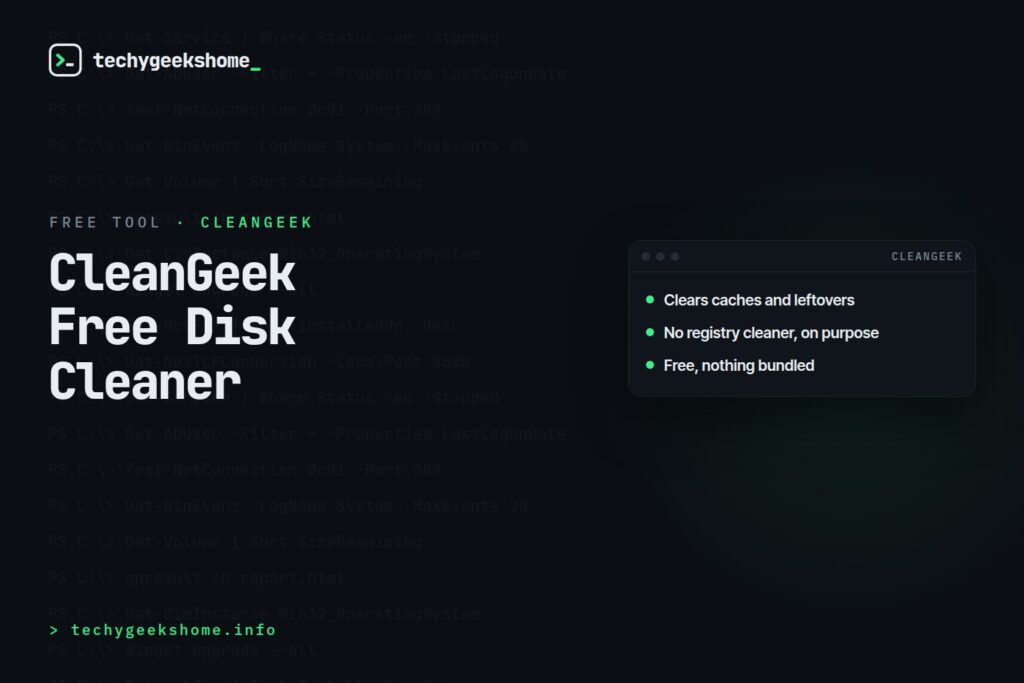
Every disk cleaner tells you it found 28 gigabytes. Almost none of them tell you that only 1.2 of those are actually ticked, or what clearing your cookies is going to cost you. CleanGeek is a free, open source disk cleaner built around the opposite habit: it measures first, tells you in plain words what each item costs, and removes only what you have ticked.
It has no registry cleaner, and that is a feature rather than an omission. It is GPL-3.0, free at work as well as at home, and it makes no network calls at all.
Quick Facts
- Free, including at work. No Pro tier, no per-seat licence, no ads and no bundled offers.
- Open source under the GPL-3.0. The full source is on GitHub and both builds are compiled by GitHub Actions, not on a developer machine.
- No registry cleaner. Deliberately, permanently, and the application says so on its own settings screen.
- Nothing risky is ticked for you. Only caches and temporary files are on by default, and an automated test fails the build if that ever changes.
- Nothing leaves your PC. It reads and deletes files locally and makes no network calls whatsoever.
- Nothing installs itself. Portable build alongside the installer, and the scheduled scan never deletes anything.
What CleanGeek does
Three screens: Clean, Installed and Startup. Everything else was either already covered by another tool in the range or was not worth building.
- Finds the space that nothing needs. Temporary files, Windows Update leftovers, the delivery-optimisation cache, crash dumps, thumbnail and icon caches, browser caches, the memory dump from a blue screen, and a previous Windows installation if you still have one.
- Shows the number before it removes anything. Scan and Clean are two separate steps, always, and the total it offers to remove is only ever the total of what you ticked.
- Says what each item costs you. Clearing cookies signs you out of nearly every site you use. Saved form data is gone for good. It is written next to the tick box in plain English, before you tick it.
- Lists everything installed, and hands an uninstall to the publisher’s own uninstaller rather than deleting their files itself.
- Shows what starts with Windows, and which entries you want to leave alone. Security software, audio, touchpads, file sync, with the reason.
- Scans on a schedule if you want it to. The scheduled run measures and writes a log; there is no command line that cleans.
What it will not do
This is the other category with a bad reputation, so, plainly:
- There is no registry cleaner and there will not be one. Nothing measurable gets faster, nothing gets more stable, and the failure mode is a machine that will not start. The upside is zero, so it is not shipping for the sake of a bullet point.
- Saved passwords are not a cleanup target. Not off by default. Absent.
- Cookies, history and saved form data are off by default, and each one tells you what clearing it costs before you turn it on.
- The Recycle Bin is emptied only when you tick it on its own, never as part of a sweep of everything else.
- Nothing outside a fixed, named list of folders is touched. No wildcard sweeps of your profile, and no deleting from the component store or Prefetch, both of which Windows manages itself.
Download CleanGeek
Two builds. The installer gives you a Start menu entry and a proper uninstall entry; the portable build is a single executable. Both are compiled by GitHub Actions and every release publishes SHA-256 hashes.
The installer is 29.1 MB and the portable build 86.5 MB. The portable one is larger because .NET is inside the executable, so there is nothing else to install either way. The CleanGeek product page has the full feature list, the screenshots and the version history.
Version 1.0.5 is the current release. It adds an About window and a Check for updates button at the foot of the sidebar. The update check asks GitHub whether there is a newer release and runs only when you press it. CleanGeek makes no other network request, and it never downloads or installs an update on its own.
Requirements
Windows 10 or Windows 11, 64-bit. No prerequisites. The .NET 8 runtime is bundled inside both builds. CleanGeek runs as a standard user for your own caches and temporary files; the machine-wide items are shown and measured either way, and are refused with an explanation rather than failing quietly if you are not an administrator.
Frequently asked
Will it delete something I actually need?
Nothing is ticked for you except caches and temporary files, which rebuild themselves. Everything with a cost is off until you turn it on, and it tells you what that cost is first. Saved passwords are not a target at all, and it never touches anything outside a fixed list of named folders.
Why no registry cleaner? Every other cleaner has one.
Because it does not work. There is no measurable benefit on any supported version of Windows, and the failure mode is a machine that will not boot. Being the cleaner that refuses to ship it is the point, not an oversight.
What about my software updates and my disk usage?
Different jobs, different tools, all free: AppGeek updates your installed software, DiskGeek shows you what is eating your disk, and DriverGeek surfaces the driver updates Windows hides. CleanGeek stays in its lane.
Why does Windows warn me when I install it?
The builds are not code-signed, so SmartScreen warns about any installer it has not seen before. The source is on GitHub and every release publishes a SHA-256 hash you can check your download against.
Gear We Recommend
Keeping a fleet of machines current is easier with the right kit on the bench. Here is what we actually use.
Browse our Admin Machine picks on AmazonAs an Amazon Associate, TechyGeeksHome earns from qualifying purchases
Disclosure: this post may contain affiliate links. If you buy through one of them, we may earn a small commission at no extra cost to you. We only recommend products we’ve tested or genuinely rate.
Discover more from TechyGeeksHome
Subscribe to get the latest posts sent to your email.
