 By Andrew Armstrong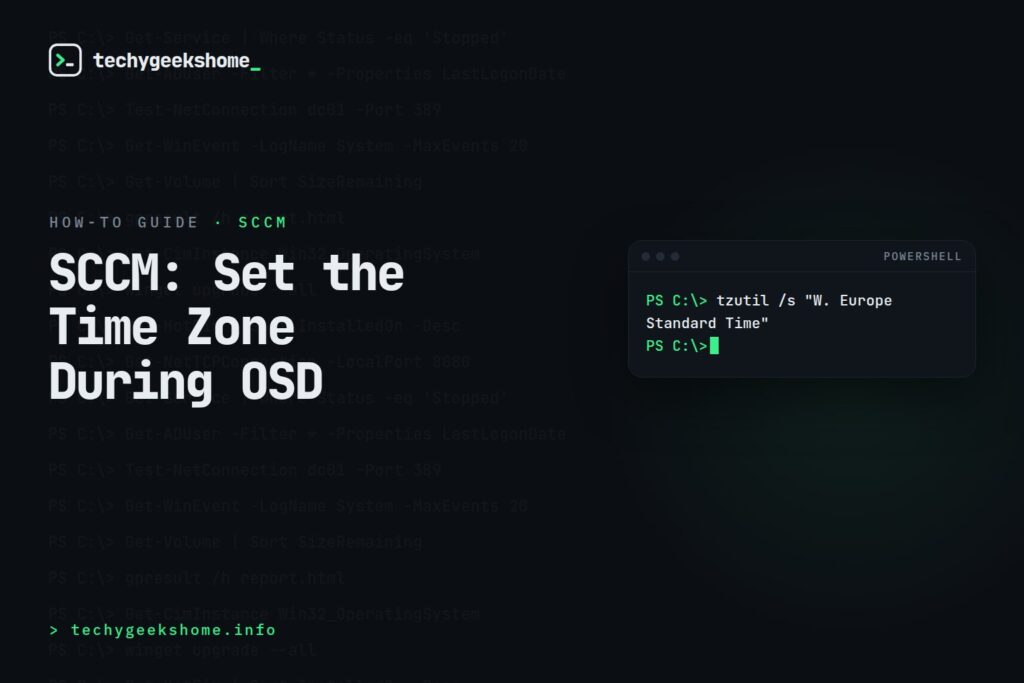
The Approach
Windows’ built-intzutil.exe tool sets the system time zone from the command line, which makes it straightforward to call from a task sequence step.
For example, to set the time zone to Western European Standard Time (Amsterdam):
tzutil /s "W. Europe Standard Time"
Adding It to Your Task Sequence
- Add a “Run Command Line” step, positioned after the “Apply Operating System” and “Apply Windows Settings” steps.
- Set the command line to
tzutil /s "W. Europe Standard Time"(or the correct time zone ID for your target region). - Set “Package” to none, since this uses a tool already present in Windows.
tzutil /l on any Windows machine, which lists every valid time zone name and its exact string: the names are precise (for example “GMT Standard Time” for UK, not simply “GMT”) so copy them exactly rather than guessing.
If you’re deploying to multiple regions, you can drive this with a task sequence variable set earlier based on collection membership or a prompt, rather than hardcoding one time zone per task sequence.
Modern Alternative: Automatic Time Zone Detection
tzutil.exe remains a valid, fully supported way to set the time zone during a task sequence, and it’s still the most predictable option for a wired build in a staging area or datacenter where the target machine may have no reliable network positioning yet. For cloud-native deployments through Autopilot/Intune, though, the more modern equivalent is enabling automatic time zone detection via location services, which Windows can drive from Wi-Fi-based positioning without hardcoding a zone at all. In practice, many organisations running a hybrid setup: an SCCM/MECM task sequence kicked off during Autopilot: still keep a tzutil step in the task sequence rather than relying solely on automatic detection, since location services and Wi-Fi positioning aren’t always dependable during the imaging stage itself. If you’re fully cloud-managed with no on-prem task sequence, though, enabling automatic time zone through your Intune device configuration removes the need to maintain a per-region command line at all.
🛠️
Gear We Recommend
Testing configs is easier with a dedicated admin machine set up right. Here’s the kit we use.
Browse our Windows Admin Toolkit picks on AmazonAs an Amazon Associate, TechyGeeksHome earns from qualifying purchases.
Discover more from TechyGeeksHome
Subscribe to get the latest posts sent to your email.
