 By Andrew Armstrong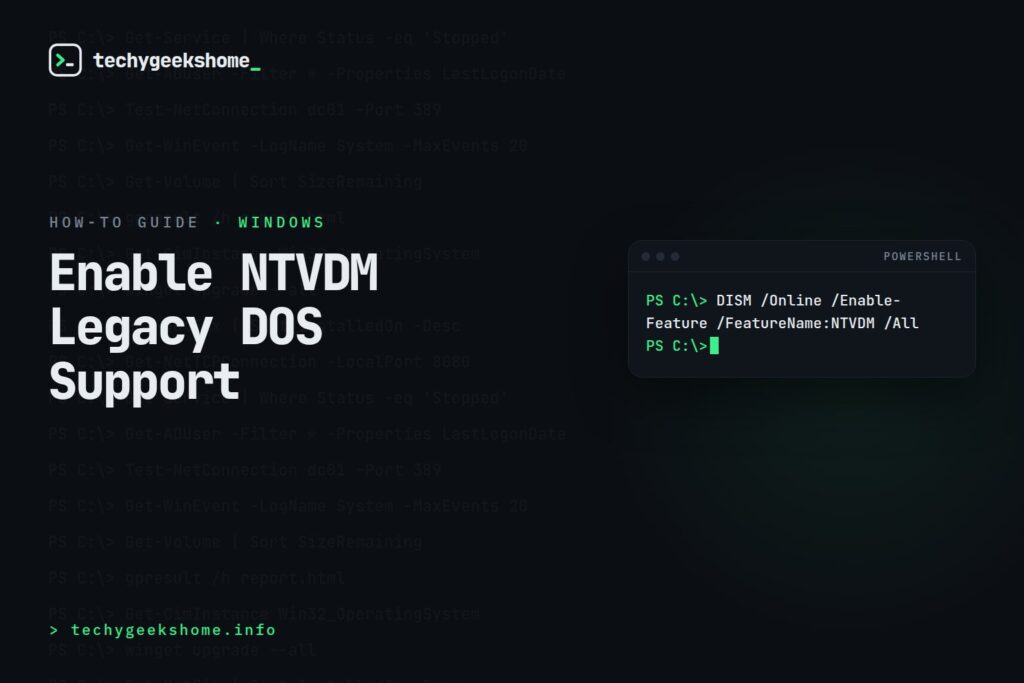
Enabling It
The simplest way is via DISM from an elevated command prompt:DISM /Online /Enable-Feature /FeatureName:NTVDM /All
Deploying at Scale
For a fleet of machines via Group Policy or SCCM, package the same DISM command as a Run Command Line task sequence step, or a startup script/scheduled task pushed via Group Policy. Since this changes an optional Windows feature rather than installing an application, it’s a lightweight, quick deployment either way.Important Caveat
NTVDM is only available on 32-bit Windows: it doesn’t exist at all on 64-bit Windows, since 64-bit Windows dropped 16-bit application support entirely. If you’re deploying to 64-bit machines and need to run genuinely old 16-bit software, you’d need a different approach (a virtual machine running an older 32-bit OS, or DOSBox-style emulation) rather than NTVDM.A Reality Check for 2026
Worth being direct about how narrow this scenario has become: Microsoft stopped supplying 32-bit builds of Windows 10 to OEMs starting with the May 2020 Update, and Windows 11 has never shipped a 32-bit edition at all: it requires a 64-bit processor outright. Combined with Windows 10 itself reaching end of support on 14 October 2025, a machine you’d actually run this DISM command on today is almost certainly an aging, out-of-production 32-bit Windows 10 install predating that 2020 cutoff, running unsupported and unpatched unless it’s covered by ESU. The feature itself still works exactly as described above on those surviving 32-bit builds, but it’s worth treating this as a legacy/retro-computing fix rather than something you’d deploy to a current fleet: if you’re supporting genuinely old 16-bit software on modern 64-bit hardware, a VM running an older 32-bit OS or DOSBox-style emulation (as already noted above) is the realistic path forward.🛠️
Gear We Recommend
A few general tech accessories worth having alongside this.
Browse our General Tech Accessories picks on AmazonAs an Amazon Associate, TechyGeeksHome earns from qualifying purchases.
Discover more from TechyGeeksHome
Subscribe to get the latest posts sent to your email.
