 By Andrew Armstrong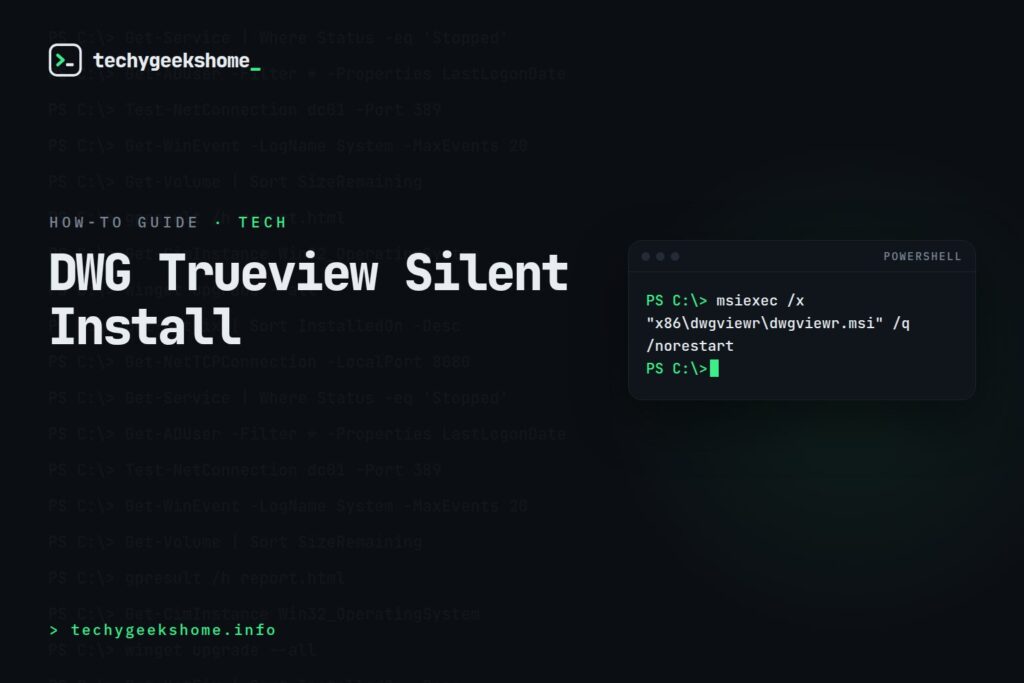
Getting the Installer
Download the DWG TrueView installer directly from Autodesk’s official download page, then extract the installation files from the downloaded executable.Silent Install (Classic / Legacy Builds)
From the root of the extracted setup files, run:setup.exe /w /t /l /q setup.ini
Uninstall (Classic / Legacy Builds)
msiexec /x "x86\dwgviewr\dwgviewr.msi" /q /norestartSwap
x86 for x64 if you’re deploying the 64-bit build.
Detection Method (Classic / Legacy Builds)
Use the same MSI as your detection rule:x86\dwgviewr\dwgviewr.msi
A Dependency to Watch For (Classic / Legacy Builds)
Classic DWG TrueView builds require the full .NET Framework 4 runtime. If your target machines might not have it, create the .NET Framework 4 redistributable as its own SCCM Application and add it as a dependency on this one, so it installs automatically as a prerequisite rather than causing the DWG TrueView install to fail silently.What’s Changed on the Current Release (2026)
Autodesk has moved DWG TrueView’s newest generation (following the same numbering as AutoCAD, so the current release is DWG TrueView 2027) off the classic setup.ini/MSI installer entirely. The extracted-installer-plus-setup.ini approach and a plain msiexec /x uninstall above are the legacy pattern: if you’re packaging a current-generation download, expect a different, ODIS-based bootstrapper instead:
- Download the current installer (an executable typically named something like
Create_Installer_..._English_WIN64.exe), then extract it silently with the-qswitch. - Run the extracted
Setup.exe -qfor a silent install, rather than the oldsetup.exe /w /t /l /q setup.inisyntax. - Uninstall goes through Autodesk’s ODIS installer framework rather than a direct MSI call: something along the lines of
"%ProgramFiles%\Autodesk\AdODIS\V1\Installer.exe" -i uninstall -q -m <path-to-bundleManifest.xml>, with the manifest path specific to your deployed version.
Resources
- DWG
- Microsoft
- I’ve added another post on how to add Microsoft Dot Net Framework as an application in SCCM here
- guide
- How to deploy AutoCAD using SCCM
- Fix AutoCAD Installation Failure: Error 1606: Could Not Access Network Location
- Browse our General Tech Accessories picks on Amazon
Discover more from TechyGeeksHome
Subscribe to get the latest posts sent to your email.
