 By Andrew Armstrong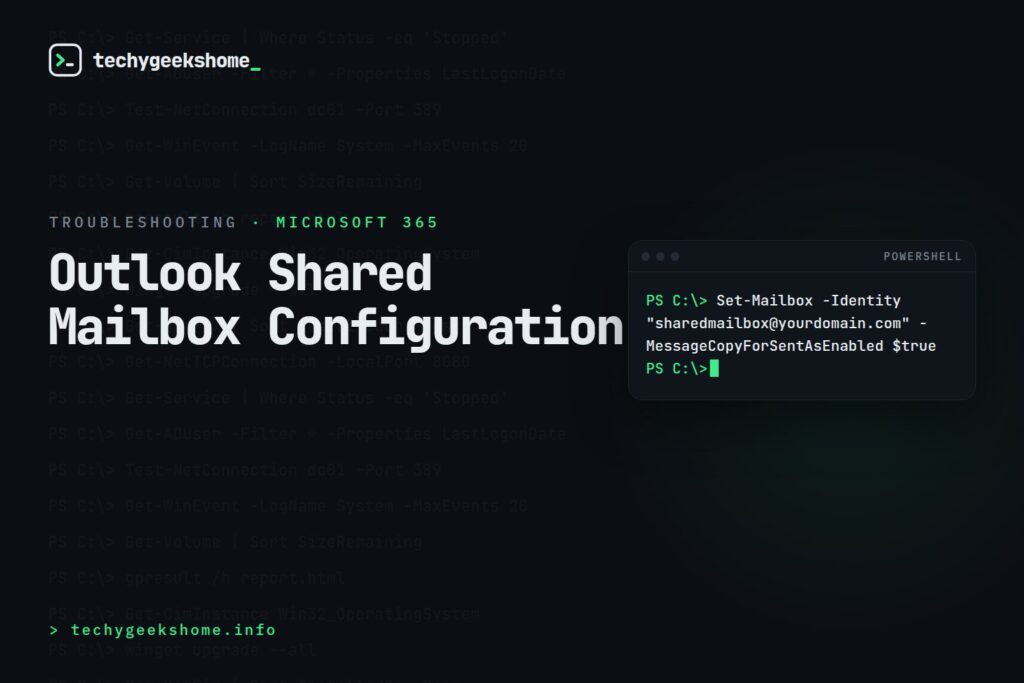
The Fix: Sent Items
This is controlled by a registry value under your own user profile:HKEY_CURRENT_USER\Software\Microsoft\Office\<version>\Outlook\Preferences DWORD: DelegateSentItemsStyle = 1Replace
<version> with your installed Outlook’s version key (for example 16.0 for Outlook 2016/2019/365). Setting this to 1 tells Outlook to file sent mail into the shared mailbox’s own Sent Items folder when you send “from” that mailbox, instead of your own.
Applying It
Set the value, then fully close and restart Outlook for the change to take effect. For a fleet rollout, this can be pushed as a registry preference via Group Policy rather than editing each machine by hand. Deleted item behaviour depends on whether the shared mailbox is added as a full additional mailbox (delegate/auto-mapped) versus opened as a separate account: if items are still landing in the wrong Deleted Items folder after the above change, check how the shared mailbox was added to the profile.The Exchange Online Way to Do This Without a Registry Edit (Updated for 2026)
The registry fix above is still valid on current classic Outlook (Microsoft 365 Apps, Outlook 2021, Outlook 2024 all share the same16.0 registry hive), confirmed directly against Microsoft’s own troubleshooting documentation. But it has one important limitation worth knowing: the newer, unified new Outlook for Windows app doesn’t read this registry value at all: Microsoft’s own documentation states explicitly that only the server-side method applies to new Outlook users.
That server-side method works in Exchange Online (and current on-prem Exchange Server) regardless of which Outlook client is used:
Set-Mailbox -Identity "sharedmailbox@yourdomain.com" -MessageCopyForSentAsEnabled $true
Set-Mailbox -Identity "sharedmailbox@yourdomain.com" -MessageCopyForSendOnBehalfEnabled $true-MessageCopyForSentAsEnabled if users send “as” the shared mailbox (the more common setup), or the SendOnBehalf variant if they send “on behalf of” it. If you’re planning a fleet-wide rollout across a mix of classic and new Outlook users, setting both the registry preference (for classic Outlook) and the server-side parameter (which covers everyone, including new Outlook) is the safest way to make sure nobody falls through the gap.
Resources
🛠️
Gear We Recommend
Working from home? Here’s the desk tech we’d recommend.
Browse our Home Office Setup picks on AmazonAs an Amazon Associate, TechyGeeksHome earns from qualifying purchases.
Discover more from TechyGeeksHome
Subscribe to get the latest posts sent to your email.
