 By Andrew Armstrong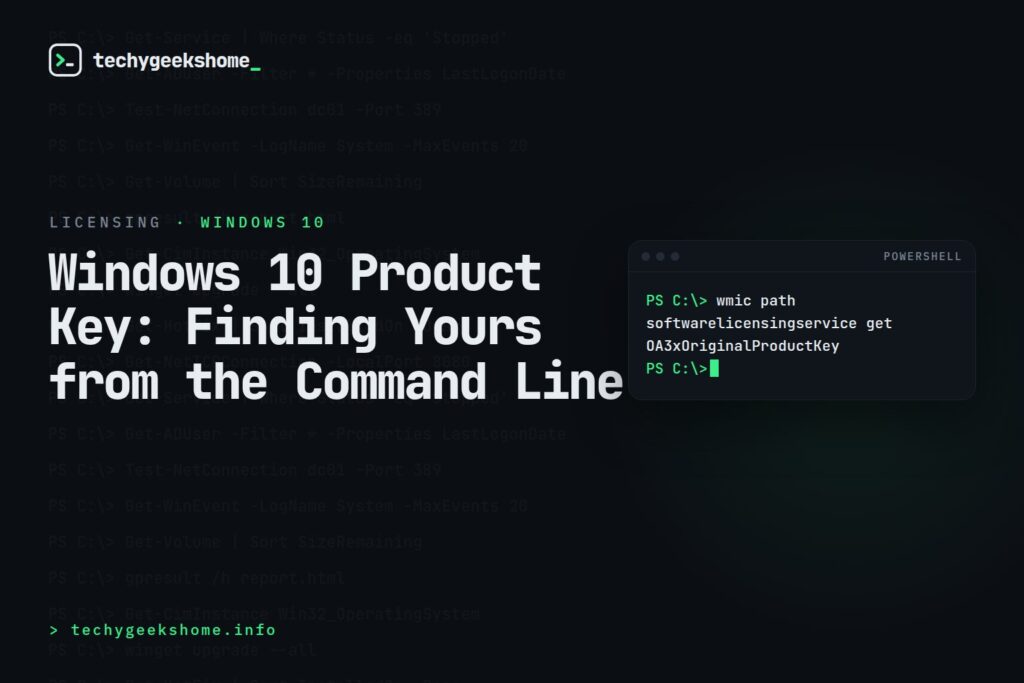
Finding Your Windows 10 Product Key
If your copy of Windows 10 came pre-installed by the manufacturer (OEM), your product key is embedded in the firmware rather than printed on a sticker, and you can pull it directly from Windows itself without needing any third-party tools. Right-click the Start button and choose Command Prompt (or Windows Terminal/PowerShell), then run:wmic path softwarelicensingservice get OA3xOriginalProductKeywmic is deprecated in current builds of Windows 11 (though usually still present on Windows 10), so if it’s missing, the equivalent PowerShell command is:
(Get-CimInstance -ClassName SoftwareLicensingService).OA3xOriginalProductKeywmic Is Being Removed: Use PowerShell Instead (Updated for 2026)
Thewmic command above still works on Windows 10, but treat it as legacy: Microsoft has been phasing it out of Windows 11 for several years, and as of Windows 11 24H2 and 25H2 it’s already removed by default on new installs and upgrades: only installable afterward as an optional Feature on Demand. Microsoft has also announced that WMIC will be removed entirely (with no FoD available) in the next Windows 11 feature update after 25H2.
In practice, this means the PowerShell command further down should now be treated as the primary method rather than a fallback, especially on any Windows 11 machine:
(Get-CimInstance -ClassName SoftwareLicensingService).OA3xOriginalProductKeyGet-CimInstance is Microsoft’s current recommended replacement for wmic generally (not just for this command): avoid Get-WmiObject as well, since that cmdlet is itself deprecated and isn’t available in PowerShell 7+.
Resources


🛠️
Gear We Recommend
A few general tech accessories worth having alongside this.
Browse our General Tech Accessories picks on AmazonAs an Amazon Associate, TechyGeeksHome earns from qualifying purchases.
Discover more from TechyGeeksHome
Subscribe to get the latest posts sent to your email.

Work with OEM and OpenLicense? Because this command line with me doesn’t work.
Yes, I just run it on Windows 10 OEM and working fine. Exactly what version of Windows are you using and have you tried opening the Command Prompt as Admin?
Work with OEM and OpenLicense? Because this command line with me doesn’t work.
Yes, I just run it on Windows 10 OEM and working fine. Exactly what version of Windows are you using and have you tried opening the Command Prompt as Admin?