 By Andrew Armstrong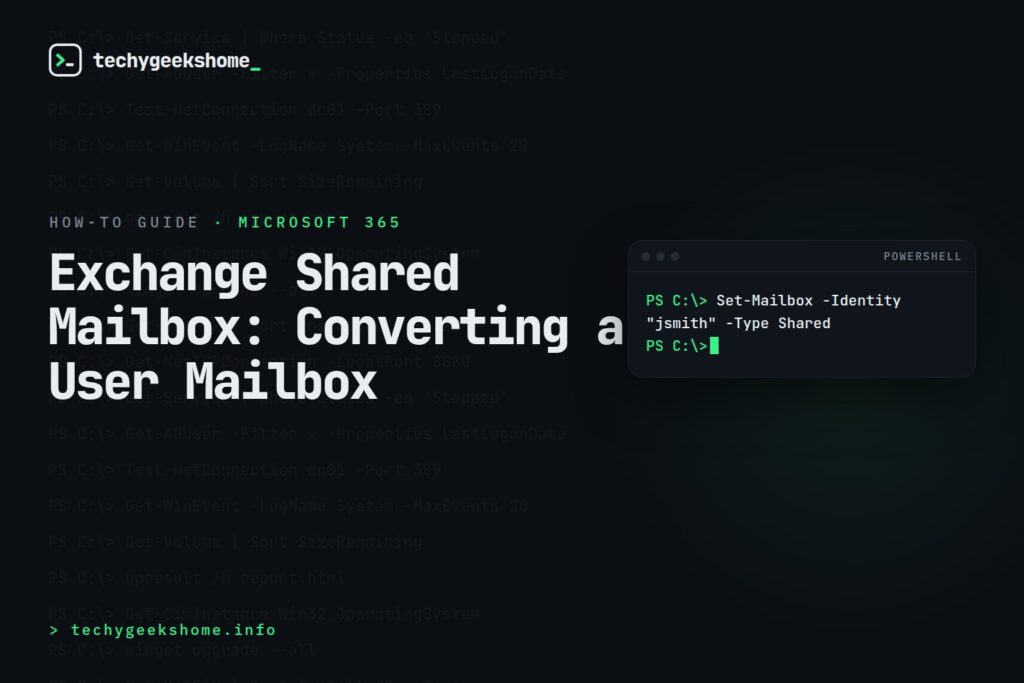
Converting an Exchange 2007 Mailbox to a Shared Mailbox
When someone leaves the business but their mailbox still needs to be accessible to a team: a departed employee’s inbox, or a generic mailbox that used to belong to a licensed user: converting it to a shared mailbox with the Exchange Management Shell is the cleanest option, since shared mailboxes don’t need their own Exchange CAL in the same way a regular user mailbox does. Run the following from the Exchange Management Shell, replacing the identity with the mailbox in question:Set-Mailbox -Identity "jsmith" -Type SharedGet-Mailbox -Identity "jsmith" | Select Name, RecipientTypeDetailsSharedMailbox rather than UserMailbox. Once converted, grant the relevant staff Full Access and/or Send As permissions with Add-MailboxPermission so they can open it from Outlook.
If you’re managing this on a modern, supported Exchange environment (on-premises 2016/2019 or Exchange Online), the same cmdlet and syntax still applies: this isn’t something that changed between versions.
Doing This in Exchange Online
The exact sameSet-Mailbox -Identity "jsmith" -Type Shared command works unchanged in Exchange Online: connect via the Exchange Online PowerShell module first (Connect-ExchangeOnline), then run it against the cloud mailbox identity. A couple of things worth doing at the same time in a cloud environment specifically:
- Once converted, the mailbox no longer needs an Exchange Online licence for the first 50GB of storage: if the departing user’s licence was dedicated to this mailbox, this is the point to remove or reassign it. Exceeding 50GB requires stepping up to Exchange Online Plan 2 (or Plan 1 with the Exchange Online Archiving add-on).
- Access is auto-mapped into the delegate’s Outlook by default the moment you run
Add-MailboxPermission -AccessRights FullAccess: add-AutoMapping $falseif you’d rather the mailbox not appear automatically for everyone you grant access to. - If staff need to reply “as” the shared mailbox without full access,
Set-Mailbox -GrantSendOnBehalfTois usually a better fit than Send As permissions.
Resources
Discover more from TechyGeeksHome
Subscribe to get the latest posts sent to your email.
